


Fort Bend County is known for its established neighborhoods and master-planned communities, where homeowners can enjoy amenities such as pools, parks, trails, recreation facilities, landscaped common areas, and community gathering spaces.
Maintaining those amenities costs money, and homeowners typically share those expenses through homeowners’ association assessments.
Understanding HOA fees in Fort Bend County before you buy can help you calculate the true cost of ownership, compare communities accurately, and avoid surprises after closing.
The amount you pay can vary considerably depending on the neighborhood, property type, amenities, and services provided by the association.
What Are the Average HOA Fees in Fort Bend County
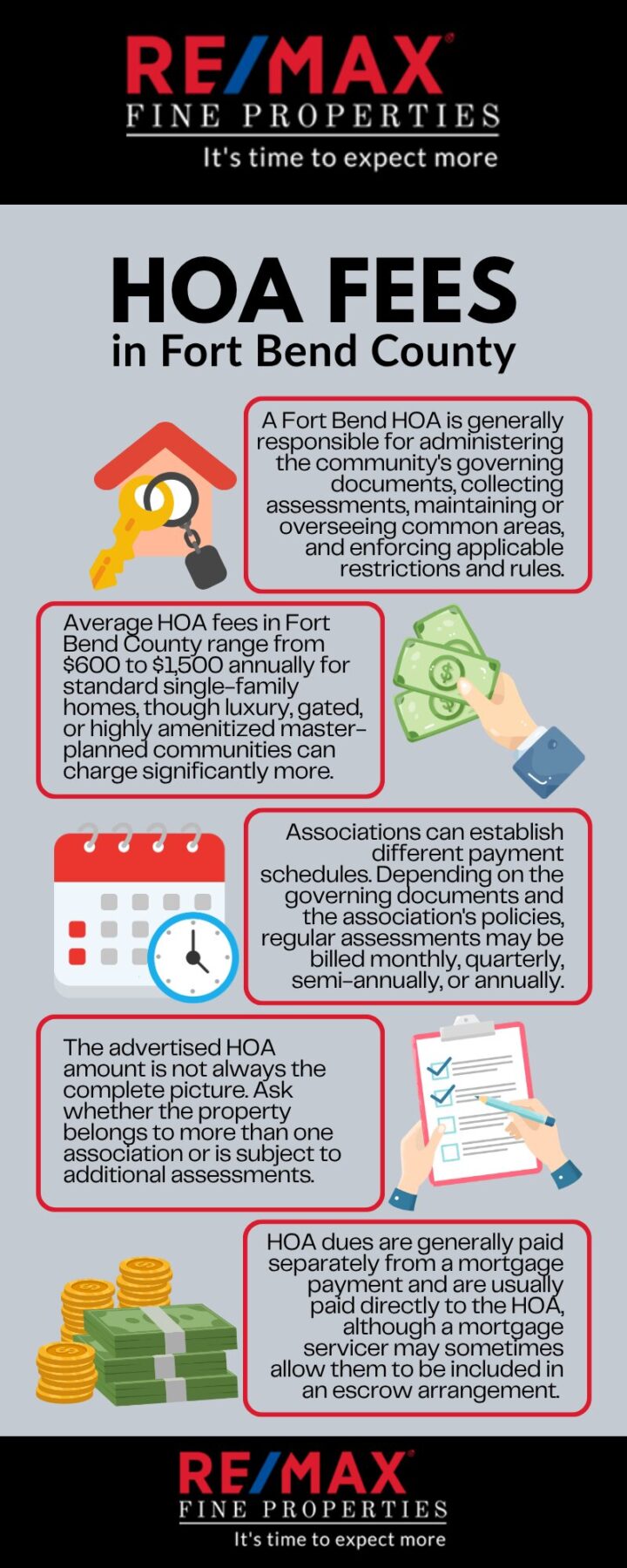
Average HOA fees in Fort Bend County typically range from $600 to $1,500 annually for standard single-family homes, though luxury, gated, or highly amenitized master-planned communities can charge significantly more. These fees are mandatory and crucial to maintaining the exceptional quality of life in the neighborhood.
Exploring Fort Bend County Homeowners Association Costs
Master-Planned Premiums
Fort Bend County homeowners’ association costs can vary based on the size and complexity of the community.
A neighborhood with only a small amount of common property may have fewer ongoing expenses than a master-planned development with multiple pools, recreation facilities, trails, parks, landscaped entrances, lakes, or other shared amenities.
Riverstone provides a useful local example. Its 2026 general annual assessment is $1,330, but the community states that some properties have additional neighborhood and/or lake assessments.
That means even homeowners within the same master-planned community may not necessarily have identical total HOA costs.
This is an important point for buyers: the advertised HOA amount is not always the complete picture. Ask whether the property belongs to more than one association or is subject to additional assessments.

Understanding the Fort Bend HOA Structure
A Fort Bend HOA is generally responsible for administering the community’s governing documents, collecting assessments, maintaining or overseeing common areas, and enforcing applicable restrictions and rules.
In newer developments, the developer may initially control the association before responsibility transitions to homeowners under the association’s governing documents.
The exact powers and responsibilities of an HOA depend on its declaration, bylaws, rules, and applicable Texas law. Buyers should therefore review the documents for the specific community rather than assume that every HOA has the same policies.
Understanding What HOA Fees Cover in Texas Communities
Maintenance and Shared Amenities
When researching what HOA fees cover in Texas communities, focus on the services and amenities your assessment actually pays for.
Depending on the association, regular assessments may contribute toward maintaining common landscaping, entrance features, parks, swimming pools, trails, recreation facilities, fitness areas, clubhouses, or other shared property.
Some communities may also have expenses associated with gated access or private security services.
The scope of services varies significantly. A community with extensive amenities can have different operating and maintenance expenses from a smaller subdivision with limited common areas.
One of the best ways to understand where your money goes is to request the association’s current budget or other available financial information.
This can help you determine whether the assessment supports amenities you will actually use and whether the association appears to be adequately planning for future expenses.
Preserving Property Values
HOA rules can also establish standards for the appearance and use of properties.
Depending on the community’s governing documents, restrictions may address landscaping, exterior modifications, fencing, parking, paint colors, or other visible changes.
These standards can help create consistency throughout a neighborhood, but buyers should not interpret HOA rules as a guarantee that property values will increase.
Home values are influenced by many factors, including location, market conditions, property condition, supply and demand, and broader economic conditions.

Evaluating Monthly HOA Dues and Assessments
Regular Dues vs Special Assessments
The phrase monthly HOA dues and assessments does not necessarily mean every homeowner pays an HOA bill every month. Associations can establish different payment schedules.
Depending on the governing documents and the association’s policies, regular assessments may be billed monthly, quarterly, semi-annually, or annually. Riverstone, for example, lists its 2026 general assessment as an annual charge.
Special assessments are separate from regular dues. An association may levy one when additional money is needed for a particular expense that cannot be adequately covered by the regular budget or available reserves.
Potential examples include major repairs, storm-related damage, infrastructure work, or other significant community expenses.
Before buying, ask whether the association has approved or proposed any special assessment. Also, ask whether the association has recently increased its regular assessment or expects to do so.
Capitalization Fees at Closing
Buyers should also investigate HOA-related charges that may be due when ownership changes.
Some associations impose transfer fees, capital contributions, reserve contributions, or similar charges at closing. These are not universal Texas HOA fees, and the amount varies by association.
For that reason, buyers should obtain a current fee schedule from the HOA or management company and confirm applicable charges with the title company before closing.
Budgeting HOA Costs for Homebuyers in Fort Bend County
Factoring Fees into Your Mortgage Approval
When calculating HOA costs for homebuyers in Fort Bend County, remember that the assessment is part of your overall housing expense.
Mortgage underwriting can account for applicable HOA dues when evaluating a borrower’s monthly obligations. Fannie Mae’s underwriting guidance includes association-related expenses in the calculation of housing expenses used for qualifying purposes.
For example, if an HOA charges $1,500 per year, that is equivalent to $125 per month for budgeting purposes, even if the association bills the homeowner annually.
Give your lender the actual HOA assessment for the property whenever possible. Using an outdated or estimated amount could give you an inaccurate picture of your monthly housing costs.

Comparing HOA Fees in Texas
When comparing HOA fees in Texas, consider the complete cost of owning the property rather than focusing on the HOA assessment alone.
Texas does not impose an individual state income tax, but homeowners are still responsible for property taxes and other ownership expenses. More importantly, property taxes in Fort Bend County vary depending on the taxing entities that apply to a particular property.
For 2025, Fort Bend County’s own tax information lists a county general fund rate of $0.412 per $100 of taxable value and a drainage rate of $0.010, for a combined county and drainage rate of $0.422 per $100.
Those figures do not represent a homeowner’s complete property-tax rate because other applicable taxing entities, such as school districts, cities, and municipal utility districts, may also levy taxes.
For buyers, the better comparison is the total annual housing cost: mortgage payment, property taxes, homeowners’ insurance, HOA assessments, utilities, and expected maintenance.
Fort Bend HOA Community Comparison Table
Because there is no authoritative countywide database establishing standard HOA charges by community type, broad dollar ranges can be misleading. The table below focuses on the factors buyers should compare instead.
| Community Type | Typical HOA Cost Pattern | Amenities Included | Typical Billing Frequency |
|---|---|---|---|
| Standard Subdivision | Varies by association and services provided | Common-area landscaping, entrance features, neighborhood maintenance | Annual, semi-annual, quarterly, or monthly |
| Master-Planned Community | Often higher when extensive amenities and common areas are provided | Pools, parks, trails, recreation facilities, clubhouses, and other shared amenities | Varies by community |
| Gated / Luxury Enclave | Varies substantially based on amenities, services, and maintenance responsibilities | Gated access, enhanced landscaping, private amenities, and potentially security-related services | Varies by association |
| Townhome Development | Can be higher because assessments may cover shared building components | Common-area maintenance and, depending on governing documents, certain exterior components | Often monthly or quarterly |
For a real-world Fort Bend example, Riverstone lists a 2026 general annual assessment of $1,330 and notes that additional neighborhood and/or lake assessments can apply to some homes.
The important lesson is to compare the services included for the fee, not simply the dollar amount. A higher assessment may cover responsibilities that an owner in another community would have to pay for separately.
Invest in Your Community Lifestyle
Buying a home in an HOA community means taking on an additional ownership expense, but the value of that expense depends on the services, amenities, maintenance responsibilities, and community standards provided in return.
Before purchasing, research the actual HOA fees in Fort Bend County for the property you want. Review the Fort Bend County homeowners association costs, determine what HOA fees cover in Texas communities, and ask about regular assessments, special assessments, transfer fees, reserves, and any additional associations affecting the property.
It is also important to include monthly HOA dues and assessments in your household budget, even when the association bills annually or quarterly. If an annual assessment is $1,500, for example, setting aside $125 per month can make the expense easier to manage.
HOA dues are generally paid separately from a mortgage payment. The Consumer Financial Protection Bureau notes that homeowners’ association dues are usually paid directly to the HOA, although a mortgage servicer may sometimes allow them to be included in an escrow arrangement.
The goal is not simply to find the community with the lowest HOA fee. It is to find a home where the complete cost of ownership fits your finances and the services and amenities provided by the Fort Bend HOA justify the expense.
If you’re considering buying a home in Fort Bend County, understanding the HOA is an important part of evaluating the property—not just after you make an offer, but before you decide what you can comfortably afford.
For help reviewing a property’s HOA costs, comparing communities, and understanding the full cost of ownership, give me a call today at (832) 641-3727 or email me at bret@bretwallace.com.
Frequently Asked Questions
Are HOA fees in Fort Bend County typically paid monthly or annually?
There is no single payment schedule for all Fort Bend County associations. Depending on the HOA, regular assessments may be paid monthly, quarterly, semi-annually, or annually. Riverstone, for example, lists its 2026 general assessment as an annual charge.
What is the difference between regular Fort Bend County homeowners association costs and special assessments?
Regular assessments fund the HOA’s ongoing operations and are recurring charges established under the association’s governing documents and budget. A special assessment is an additional charge imposed for a specific financial need. It may be used for a major repair, unexpected expense, or project that cannot be adequately funded through regular assessments and existing reserves.
Can my Fort Bend HOA foreclose on my home if I do not pay the fees?
Texas law allows qualifying HOA assessment liens and provides a process for foreclosure, but an HOA generally must obtain a court order before foreclosing an assessment lien under Texas Property Code Chapter 209, subject to statutory exceptions and requirements. Because the consequences of unpaid assessments can be serious, homeowners who are behind on HOA payments should obtain advice from a qualified Texas attorney about their specific situation.
How do I find out exactly what HOA fees cover in Texas communities before closing?
Ask for the HOA’s governing documents, current assessment information, applicable fee schedule, budget or financial information, and other resale or disclosure documents available for the property. Your real estate agent and title company can also help identify HOA-related charges that may apply to the transaction.
Are monthly HOA dues and assessments included in my mortgage escrow account?
Usually, HOA dues are paid separately from the mortgage payment. The CFPB states that homeowners’ association dues are generally paid directly to the HOA rather than the mortgage servicer. In some circumstances, a servicer may allow HOA dues to be included in escrow.
Do HOA costs for homebuyers in Fort Bend County increase every year?
They can, but there is no universal annual increase that applies to every HOA. Associations prepare budgets based on their expected operating expenses, maintenance needs, reserves, insurance costs, and other financial obligations. Assessments can therefore change from year to year depending on the association’s circumstances.
How do HOA fees in Texas compare to property taxes in Fort Bend County?
They are separate expenses and serve different purposes. HOA assessments are paid to a private association to fund the services and responsibilities established by its governing documents. Property taxes are imposed by applicable governmental taxing entities.