

If you’ve been watching Houston’s growth pattern over the past decade, one thing becomes very clear: infrastructure leads, and real estate follows.
The Grand Parkway (SH 99) is the clearest example of that principle in action. As each segment opens, it doesn’t just move traffic—it reshapes where people live, shop, and invest.
What makes this expansion especially important is its scale. Unlike shorter highway projects, the Grand Parkway is a massive outer loop designed to connect multiple counties, easing pressure from Houston’s inner loops and unlocking entirely new suburban markets in the process.
Right now, buyers and investors are paying close attention because the Grand Parkway expansion’s impact on real estate is already visible—and still accelerating.
Closely tied to that is the SH 99 expansion property value impact, which continues to redefine affordability, accessibility, and long-term growth potential across Greater Houston.
What Is the Grand Parkway Expansion Impact on Real Estate?
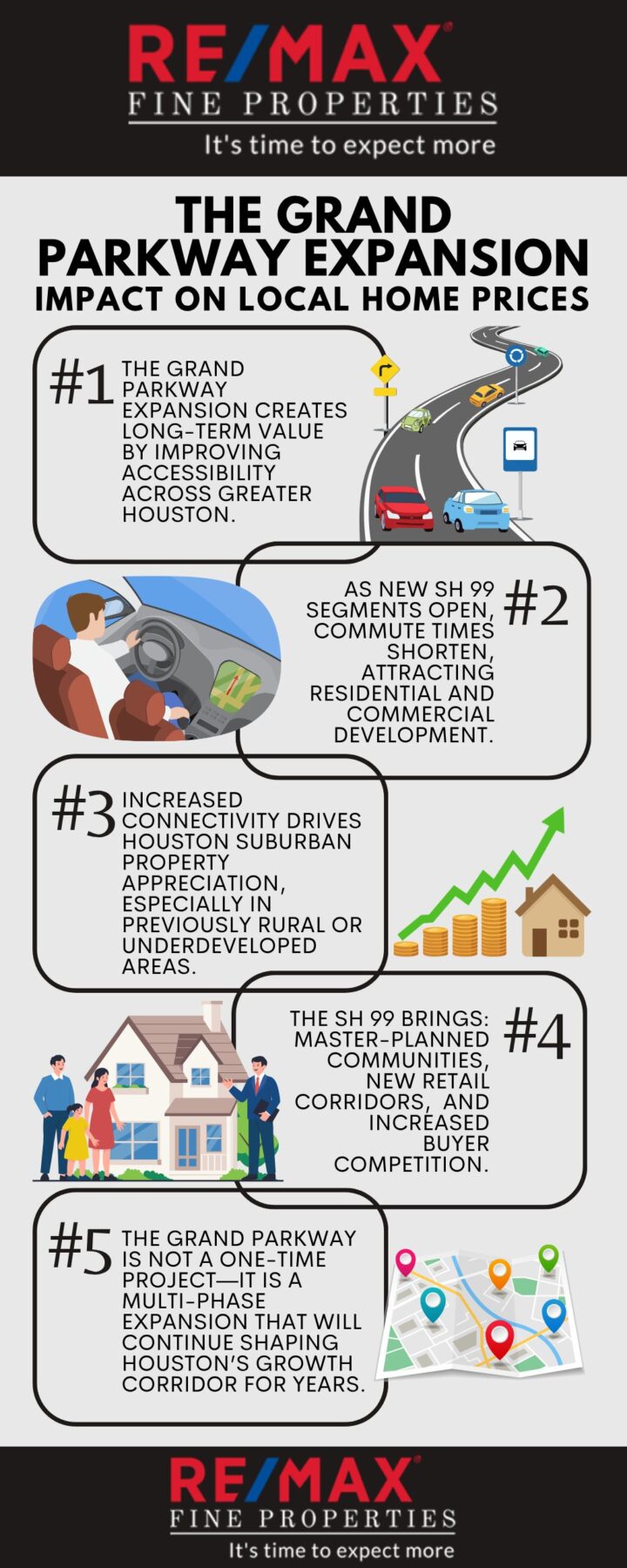
The Grand Parkway expansion’s impact on real estate creates long-term value by improving accessibility across Greater Houston. As new SH 99 segments open, commute times shorten, attracting residential and commercial development. This increased connectivity drives Houston suburban property appreciation, especially in previously rural or underdeveloped areas.
Evaluating the SH 99 Expansion Property Value Impact
The Accessibility Premium
One of the most consistent patterns in real estate is simple: when accessibility improves, value follows.
The SH 99 expansion property value impact is most noticeable in the early years after a new interchange opens. Suddenly, areas that once felt remote become viable commuter zones. That shift brings:
- Master-planned communities
- New retail corridors
- Grocery chains and essential services
- Increased buyer competition

Developers tend to move quickly into these newly accessible pockets, which accelerates land absorption and pushes home prices upward faster than surrounding areas.
Long-Term Investment Stability
Homes located within roughly a five-minute drive of SH 99 access points historically experience stronger appreciation curves than those deeper in suburban subdivisions.
That proximity creates a “convenience premium,” meaning buyers are willing to pay more for reduced commute friction. Over time, this supports stable equity growth and makes early purchases particularly attractive for long-term investors.
Reviewing the Segment B-1 Construction Status 2026
Current Progress
The Segment B-1 construction status 2026 remains a focal point for developers and land investors, particularly as this portion pushes connectivity further south toward the Alvin area.
Even while under active construction, this segment is already influencing land pricing patterns. Builders are acquiring land ahead of completion, anticipating future demand once the roadway becomes fully operational.
Managing Buyer Expectations
Buying near active highway construction can be a mixed experience. On one hand, early buyers often secure lower prices. On the other, there may be:
- Temporary traffic rerouting
- Ongoing construction noise
- Limited immediate access in some areas
For many buyers, the trade-off is worth it—especially when they understand the long-term upside tied to completion.
Following the TxDOT Grand Parkway Timeline
Tracking Completion Dates
Staying aligned with the TxDOT Grand Parkway timeline is one of the smartest strategies for both buyers and investors. Each segment opening marks a measurable shift in surrounding property values.
Those who monitor the timeline closely can better anticipate:
- When new exits open
- Where development pressure will shift next
- Which areas are entering early appreciation phases
Future Development Phases
The Grand Parkway is not a one-time project—it is a multi-phase expansion that will continue shaping Houston’s growth corridor for years.
Understanding where future segments are planned provides a strategic advantage, allowing buyers to position themselves “ahead of the wave” rather than chasing it.
Understanding Greater Houston Outer Loop Connectivity
Redefining the Commute
The expansion of Greater Houston’s outer loop connectivity is changing how residents move across the metro area.

Instead of relying on congested inner loops, drivers can now bypass central Houston when traveling between major hubs like:
- Katy
- The Energy Corridor
- Baytown
- The Bay Area / Clear Lake region
This shift is especially important for professionals whose jobs require cross-city travel.
Commercial Growth Follows the Road
A consistent rule in real estate: where highways go, businesses follow.
As SH 99 expands, we’re seeing rapid growth in:
- Grocery and retail centers
- Healthcare campuses
- Entertainment hubs
- Service-based commercial zones
This commercial layer reinforces residential demand, further strengthening neighborhood desirability.
Analyzing Alvin, TX Real Estate Trends
The Next Frontier
Looking south, Alvin, TX, real estate trends show a clear transition from rural acreage to suburban expansion zones.
What was once primarily farmland is now attracting:
- New subdivisions
- Build-to-rent communities
- Early-stage master-planned developments
Much of this momentum is driven by the anticipation of future Grand Parkway connectivity.

Affordability Meets Growth
Compared to more established western suburbs, Alvin still offers relatively accessible entry pricing. That combination—affordability plus growth potential—is exactly what first-time buyers and long-term investors look for when identifying high-upside markets.
Spotlighting League City Infrastructure Growth
A Booming Coastal Hub
The League City infrastructure growth story is closely tied to regional highway expansion.
As SH 99 edges closer to key corridors near I-45, League City is simultaneously expanding:
- Local road networks
- Utility capacity
- Community infrastructure
This dual expansion supports sustained population growth.
Sustained Property Demand
League City continues to benefit from three powerful drivers:
- Strong school systems
- Proximity to the Gulf Coast
- Improved highway connectivity
That combination consistently places it among the most in-demand suburban markets in the Greater Houston area.
Infrastructure and Value Comparison Table
| Development Phase | Market Condition | Buyer Opportunity |
|---|---|---|
| Pre-Construction (Planning) | High speculation / low prices | Excellent (long-term hold) |
| Active Construction | Moderate prices / growing pains | Very good (value acquisition) |
| Immediate Post-Completion | Rapid appreciation / high demand | Good (turnkey living) |
| Established Highway Zone | Stable high value/premium prices | Safe (consistent equity) |
Key Takeaway: Invest in the Path of Progress
Infrastructure is one of the most reliable drivers of long-term real estate value. The Grand Parkway expansion demonstrates this clearly across every stage of development.
By understanding the Grand Parkway expansion’s impact on real estate and tracking the TxDOT Grand Parkway timeline, buyers can strategically position themselves ahead of appreciation cycles.
Whether analyzing the Segment B-1 construction status 2026 or watching League City infrastructure growth, the same principle applies: connectivity creates demand.
As Greater Houston outer loop connectivity continues to improve, markets like Alvin and surrounding corridors are experiencing measurable Houston suburban property appreciation, reinforced by the ongoing SH 99 expansion property value impact.
Ready to Explore Opportunities Along the Corridor?
If you’re thinking about buying, investing, or just want a clearer picture of where Houston’s next wave of growth is heading, now is a great time to take a closer look at the areas surrounding the Grand Parkway expansion.
These corridors are evolving quickly, and having the right guidance can make a real difference in identifying strong opportunities before they fully take off.For more details or to discuss what’s happening in these emerging markets, you can reach out directly by calling (832) 641-3727 or emailing bret@bretwallace.com.
Frequently Asked Questions
How does the SH 99 expansion property value impact affect older homes?
Older homes near new access points often experience indirect appreciation due to increased demand for nearby established neighborhoods.
What is the latest TxDOT Grand Parkway timeline?
Completion timelines vary by segment, and updates are published periodically as construction progresses.
How are Alvin, TX, real estate trends changing?
Alvin is shifting toward suburban development with increased investor and builder activity ahead of infrastructure completion.
Does the Grand Parkway expansion impact commercial real estate?
Yes. Retail, healthcare, and logistics development typically accelerate alongside residential growth.
Which areas are seeing the highest appreciation?
Markets along SH 99 corridors, including parts of Alvin and League City, are seeing strong upward pressure.
How does Segment B-1 construction affect commuting?
Temporary traffic changes may occur, but long-term improvements significantly reduce regional travel times.
Will League City keep up with demand?
Current infrastructure expansion suggests ongoing efforts to match residential growth driven by improved connectivity.